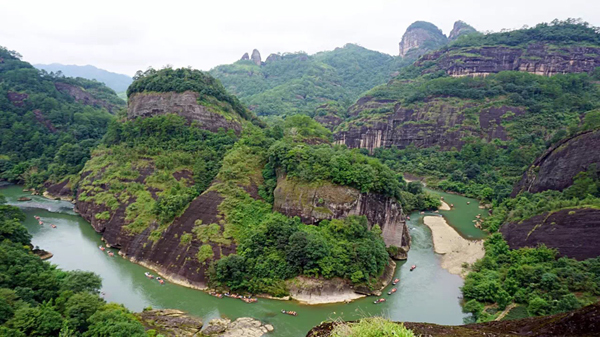
Wuyi Mountain
Introduction
Wuyi Mountain, located in the southeast province of Fujian in China, is a celebrated mountain range that stands as one of the premier examples of the Chinese Subtropical Forest and the South Chinese Rainforest. It holds the distinction of being a mixed site recognized for both its cultural and natural significance. In 1999, it was inscribed on the UNESCO World Cultural and Natural Heritage Lists, acknowledging its immense value for biodiversity conservation and its rich historical and cultural heritage.
Natural Heritage
The Wuyi Mountain Range, often referred to as Greater Wuyi Mountain, extends over 500 kilometers across Fujian and Jiangxi provinces, with peaks averaging over 1,000 meters above sea level. The scenic area known as Small Wuyi Mountain is particularly renowned for its picturesque landscapes. This area is characterized by its unique Danxia landform, featuring the Stream with Nine Turnings, 36 peaks, 72 caves, and 99 rocks. The spectacular views of red sandstone monoliths surrounded by lush green waters have captured the imagination of many.
Biodiversity
Wuyi Mountain serves as a sanctuary for numerous ancient plant species, many of which are endemic to China. The area is home to an incredibly diverse array of flora and fauna, including significant populations of reptiles, amphibians, and insects. Its complex landscape, warm and humid climate, and well-preserved vegetation provide an ideal environment for biodiversity to flourish. Wuyi Mountain boasts approximately 3,000 species of higher plants and over 840 species of lower plants, supporting more than 7,000 species of animals, including a wide variety of insects and mammals.
Cultural Heritage
Wuyi Mountain is not only a natural wonder but also a site of profound cultural significance. It is recognized as the birthplace of Neo-Confucianism, a philosophy that has profoundly influenced Eastern and Southeastern Asia for centuries. The area contains numerous archaeological sites, such as Han City, which was established in the 1st century BC, and various temples and study centers linked to the development of Neo-Confucianism in the 11th century.
Wuyi Tea
Wuyi Mountain is famous for producing some of the world's most esteemed teas, including Lapsang Souchong and Da Hong Pao. Known in English as "Bohea" in the past, Wuyi tea encompasses both black and oolong varieties. The region's rocky, mineral-rich soil imparts a distinctive terroir to these teas, often referred to as "rock teas" (yancha). With a long history of tea production, Wuyi Mountain continues to be a major center for tea cultivation, and its teas are highly prized internationally.
Legends and Stories
Wuyi Mountain is steeped in legend, with stories that add to its mystical allure. One popular tale is that of Yunv Peak, where a fairy maiden named Yunv fell in love with an earthly king, Dawang. Their love was thwarted by a demon named Tieban, who informed the Jade Emperor. In a fit of rage, the Jade Emperor turned Tieban into a peak to separate Yunv from Dawang, symbolizing their eternal separation despite their proximity.
Conservation and Management
The protection of Wuyi Mountain is paramount to preserving its unique biodiversity and cultural heritage. Rangers at Wuyishan National Park work diligently to safeguard the area from threats such as fire and poaching, ensuring the continued survival of its diverse ecosystems. Advanced technologies, including real-time satellite imagery and drone patrols, have been implemented to enhance the efficiency of conservation efforts. These measures, coupled with the dedication of local authorities and park personnel, have led to significant improvements in the ecological environment of Wuyi Mountain, attracting both bird-watching enthusiasts and biological researchers.








